
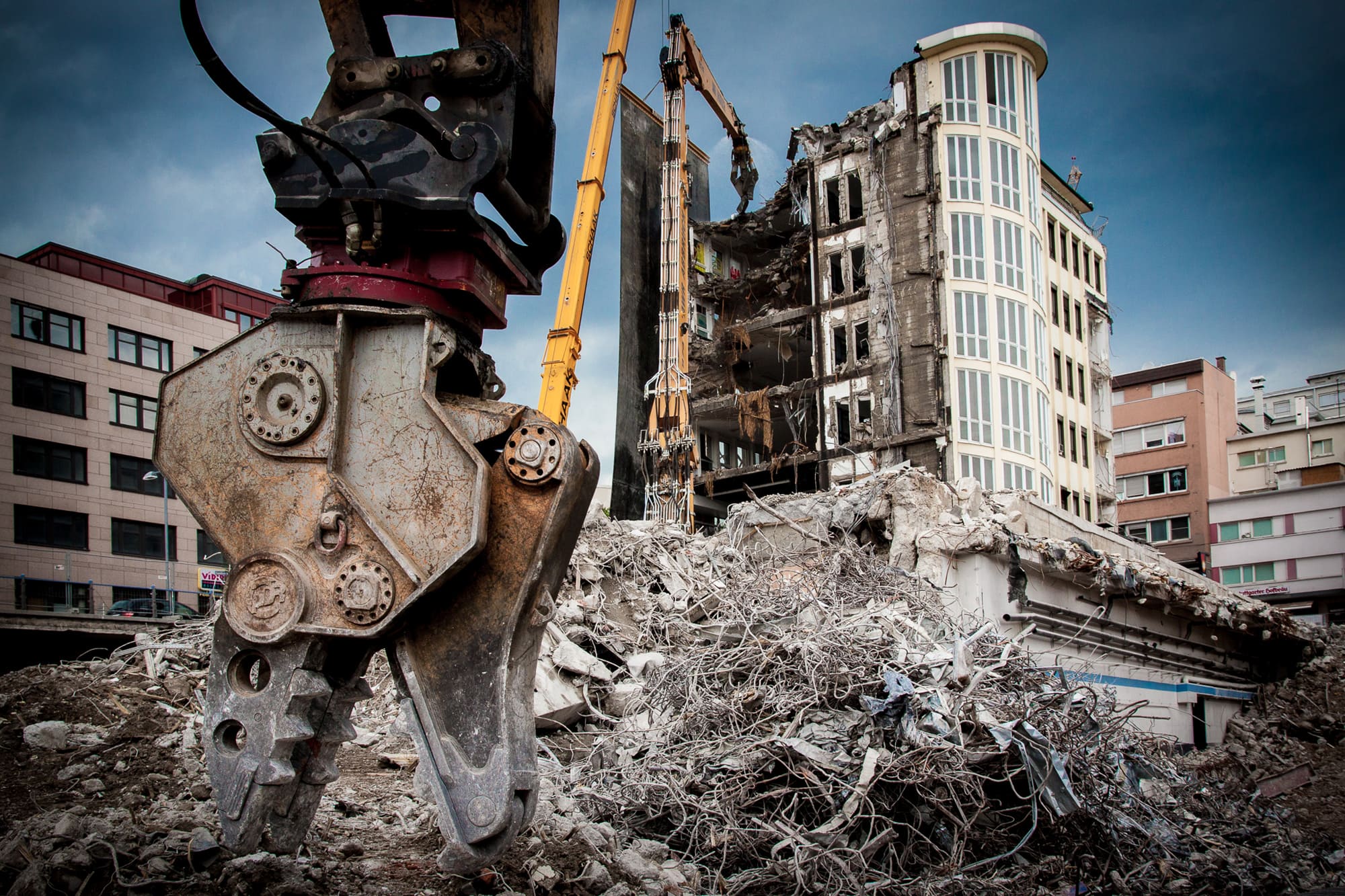
Practical Guide to Selective Demolition and Renovation of Existing Buildings
Resource-efficient approaches are becoming increasingly important in the refurbishment of existing buildings. The ‘Practical Guide to Selective Demolition and Refurbishment of Existing Buildings’, to which we contributed as technical lead, offers specific recommendations for action and supports all those involved in the construction process in planning demolition processes in a legally compliant manner, keeping costs under control, and ensuring that environmental and health protection are taken into account in a professional manner.
Why a guide to selective demolition and renovation of existing buildings?
With a building stock of around 22 million buildings and a wave of refurbishment due to take place, the construction sector plays a key role in shaping how existing buildings are managed. Selective demolition is a key tool in this regard: it comes into play precisely where buildings are to be retained, purposefully converted or partially demolished – and where decisions are made as to which materials are to be reused, which must be treated in accordance with best practice, and which must be disposed of.
The guide helps to structure this process and highlights which technical decisions should be taken early on in the project in order to avoid subsequent conflicts, additional costs and delays. It is worth noting that, for the first time, numerous new technical and statutory regulations are taken into account and summarised here.
Who is this guide intended for?
The guide is aimed at everyone involved in the construction process – from project sponsors, clients, designers and surveyors to contractors and public authorities.
In particular, it offers:
- a structured introduction for those new to demolition and renovation of existing buildings, for example in the construction and environmental sectors,
- a common framework to which project stakeholders can refer during the planning, procurement and execution phases,
- guidance for investors and project developers to help them understand their roles and responsibilities within the demolition process and make the right decisions at an early stage.
What is covered in the guide?
The focus is on the services provided by surveyors and planners in connection with forthcoming work on existing buildings and technical installations. The guide describes:
- what information needs to be gathered early in the project to enable a well-founded assessment: history of use, years of construction and alterations,
- how the technical investigation of the building fabric is structured – from the investigation programme and sampling plan through to the evaluation of laboratory results,
- how these findings are used to develop demolition concepts that provide planning certainty and take environmental and health protection into account,
- how these concepts are implemented throughout the tendering, contract award, execution and documentation phases.
In this context, the relevant areas of law – including waste management, hazardous substances, environmental and health and safety legislation – are organised in such a way that they can be taken into account in a transparent manner throughout the course of the project.
Support for day-to-day practice
The guide serves as a working basis: it brings together experience gained from projects, translates numerous new sets of regulations into practical steps, and demonstrates how technical decisions can be justified during the decommissioning process.
Download it here and use it for your next project:
Praxiswissen zum selektiven Rückbau und Bauen im Bestand
More success stories

Why work with us?
More than 75 years of experience
Since 1948, GINGER HPC has combined expertise and precision in environmental and engineering projects – ensuring reliable solutions that stand the test of time.
Strong international network
With offices across Europe, as part of the Ginger Group and as a founding member of the Inogen Alliance, we bring global insights and local expertise to every project.
Outstanding Quality
Our quality speaks for itself: Awards such as the EcoVadis Silver 2026, as well as ISO 9001 and 14001 certifications, underscore our high standards. They symbolize trust, efficiency, and quality – values that have guided us from the very beginning.
Our Service Areas
Land Recycling
Experience. Responsibility. Worldwide.
Life is constantly evolving. New buildings and installations are emerging on freely available land. Elsewhere occupied land is being redeveloped and…
Environment and Safety
Experience. Responsibility. Worldwide.
The environment and our living conditions determine our quality of life. Development entails changes. Environmental development is the result of many…
Infrastructure
Experience. Accountability. Valorisation.
Regional economic objectives of investment-related infrastructure policies can only be achieved by thorough infrastructure planning. Infrastructure…
Got a project in mind?
We have the solution.